Updated September 22, 2026. Water has never been a minor infrastructure issue for DHA Karachi. For many households, an unreliable supply eventually becomes a question of tanker dependence, storage capacity and how consistently water reaches the property.
That is why the new Dumlottee pipeline matters.
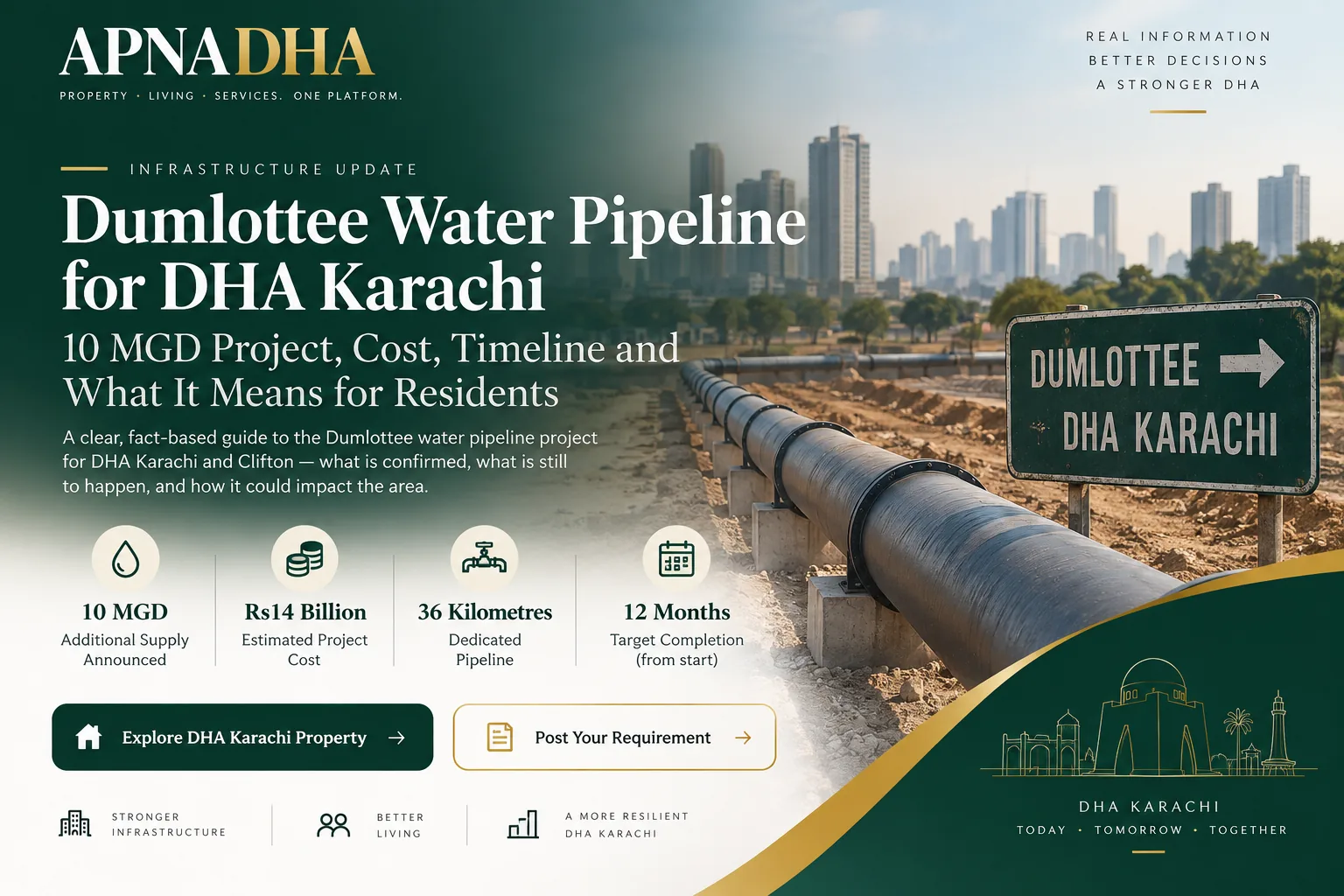
On 12 September 2026, the Karachi Water and Sewerage Corporation and Frontier Works Organisation signed an agreement for a dedicated water pipeline intended to bring an additional 10 million gallons per day (MGD) to Defence and Clifton. The announced construction cost is about Rs14 billion, with a target of completing the project within 12 months of construction beginning.
But there is an important distinction. An agreement has been signed. Funding and project scope have moved forward. A construction timetable has been announced. That is not the same thing as a completed water solution — and, as of 22 September 2026, ApnaDHA has not found sufficiently authoritative evidence confirming that physical construction has actually started.
For residents and property buyers, the useful question is therefore not whether the project sounds promising. It is what has genuinely been confirmed, what still has to happen, and what the project could change if it is delivered as planned.
What Has Actually Been Confirmed?
The project itself is not a new announcement.
In July 2025, the Sindh cabinet approved an interest-free loan of Rs10.56 billion for a dedicated water-supply scheme from Dumlottee to DHA. The official scope included a 36-kilometre pipeline, together with a pumping station, forebay and filtration plant. The Sindh government said at the time that DHA was receiving only around 4–5 MGD of water and directed that the project be completed on an accelerated timeline. Read the Sindh government project announcement.
By February 2026, the provincial cabinet had approved awarding the 36-kilometre project to the Frontier Works Organisation. The Sindh government later confirmed the FWO award.
The cost was subsequently revised. In July 2026, the engineering, procurement and construction cost was increased to Rs14.237 billion. The reported reasons included design changes, pipeline material, taxes, inflation, completion of filtration facilities and the addition of monitoring requirements. Dawn reported the revised EPC cost and reasons for the increase.
The latest major milestone came on 12 September, when KWSC and FWO formally signed the construction agreement. Mayor Karachi Murtaza Wahab said the completed project would provide an additional 10 MGD to Defence and Clifton, that construction would begin the following week, and that completion was targeted within 12 months. Read the 12 September agreement report.
Project Status — Last Checked 22 September 2026
| Project item | Current position |
|---|---|
| Dedicated Dumlottee–DHA pipeline | Confirmed project |
| KWSC–FWO agreement | Signed |
| Planned pipeline length | Approximately 36 km |
| Additional supply | 10 MGD announced |
| Revised EPC cost | Rs14.237 billion |
| Pumping / filtration infrastructure | Included in reported project scope |
| Completion target | 12 months from construction commencement |
| Physical construction started | Not independently confirmed by ApnaDHA yet |
That last line matters.
The 12 September announcement said work would begin the following week. However, a fresh review of official updates and credible reporting has not yet produced sufficiently strong evidence that excavation, pipe-laying or other physical works have begun.
Until that changes, ApnaDHA will describe the project as contracted and scheduled for construction, rather than saying that construction is underway.
Why Does an Additional 10 MGD Matter?
Ten million gallons per day is a meaningful quantity when looked at specifically in the context of Defence and Clifton.
It does not mean that every street will suddenly receive uninterrupted water, nor does it automatically remove operational, distribution or local network constraints after the main pipeline is completed.
The project is better understood as an attempt to increase the amount of dedicated supply available to the area.
Whether that produces a noticeable improvement at individual properties will ultimately depend on more than the transmission line itself. Distribution arrangements, pumping, local infrastructure, allocation and operational reliability will still matter.
10 MGD is meaningful additional capacity — not a guarantee of 24-hour water at every DHA property.
Why Did the Project Cost Rise?
The original 2025 approval was around Rs10.56 billion. By July 2026, the reported EPC cost had risen to Rs14.237 billion — an increase of roughly 40 per cent.
According to the provincial briefing reported at the time, the increase was linked to factors including revised engineering design, changes in pipeline material, taxes, inflation, filtration-related work and monitoring systems.
That distinction is useful because a cost increase does not, by itself, tell us whether a project has become better or worse. The more important questions are whether the revised scope is properly delivered, whether the final system performs as intended, and whether the announced completion timetable is met.
What Could This Mean for DHA Karachi Residents?
If the project is completed as planned and the additional allocation reaches the intended distribution network reliably, the most obvious potential benefit is reduced pressure on an area that has historically faced water shortages and significant tanker dependence.
For residents, that could eventually mean greater predictability.
But it would be premature to say that tanker dependence is about to disappear or that DHA’s water problem has been solved. The pipeline still has to be physically constructed, commissioned and integrated into the working water-supply system.
That is why progress should be judged through milestones rather than announcements.
- Confirmed mobilisation and physical construction.
- Visible pipeline-laying progress.
- Pumping and filtration infrastructure completion.
- Testing and commissioning.
- Confirmation that additional water is actually entering the Defence / Clifton system.
Does This Change the DHA Karachi Property Market?
Infrastructure matters in real estate, particularly when it affects daily living.
A property with more dependable utilities is easier to live in than an otherwise similar property facing recurring supply problems. Buyers also routinely consider water, electricity, drainage, road access and other services when comparing locations.
But one infrastructure announcement should not be converted into an automatic investment claim.
It would be misleading to say that the Dumlottee pipeline will cause DHA Karachi property prices to rise, or that certain phases will appreciate because of it.
Property values depend on many factors: exact location, street, plot characteristics, construction quality, market liquidity, seller expectations, buyer demand and the wider economic environment.
A successfully delivered water project would improve an important piece of DHA Karachi’s residential infrastructure. Its eventual property-market effect should be assessed only after the system is operational and its practical impact becomes visible.
What Buyers Should Ask in the Meantime
Anyone purchasing a house or apartment should continue evaluating the water situation at the specific property, rather than assuming the planned pipeline has already changed conditions.
- What water supply does the property receive today?
- How frequently is tanker water required?
- What storage capacity does the house or building have?
- What do neighbouring residents experience?
- Is the situation different in summer or periods of high demand?
- What is the monthly practical cost of supplementary water?
These questions remain relevant until the new infrastructure is completed and its real-world effect can be measured.
A Project Worth Following — but Not Getting Ahead Of
The Dumlottee pipeline has moved beyond being merely an idea.
The scheme has provincial approval, a defined infrastructure scope, a revised budget, an FWO award and now a signed KWSC–FWO agreement. The announced objective is clear: provide an additional 10 MGD of water to Defence and Clifton.
That makes it an important project for DHA Karachi. It does not make it a completed one.
For now, the most credible position is to recognise the significance of the agreement while watching the next stage closely: actual construction on the ground.
ApnaDHA will update this page when physical work, project progress or commissioning is confirmed through reliable sources.
Frequently Asked Questions
What is the Dumlottee water pipeline project?
It is a planned dedicated water-supply pipeline connecting Dumlottee with DHA Karachi, supported by pumping, filtration and related infrastructure.
How much additional water is planned for DHA and Clifton?
Officials have announced an additional supply of 10 million gallons per day (MGD) after completion of the project.
How long is the pipeline?
The Sindh government’s approved project scope describes approximately 36 kilometres of dedicated pipeline.
How much will the project cost?
The revised engineering, procurement and construction cost reported in July 2026 is Rs14.237 billion.
When will the Dumlottee pipeline be completed?
The latest announcement sets a target of 12 months from commencement of construction. This should be treated as a project target rather than a guaranteed completion date.
Has construction started?
As of ApnaDHA’s 23 September 2026 review, the agreement and planned construction timetable are confirmed, but we have not found sufficiently authoritative evidence to independently confirm that physical construction has started.
Editorial note: ApnaDHA is an independent private real-estate and property-information platform and is not affiliated with, endorsed by, sponsored by or operated by Defence Housing Authority. Infrastructure details in this article are based on government statements and established reporting available at the time of review. Project costs, schedules and implementation status may change.