Understanding Market Cycles, Why DHA Karachi Property Prices Stagnate for Years (2026 Guide)
Many investors enter DHA Karachi expecting steady appreciation.
Yet a common frustration appears after 2–4 years:
“Why has my DHA property not increased in price?”
Price stagnation in DHA does not mean market failure. It usually reflects cycle timing, phase maturity, or entry mistakes.
This guide explains why DHA property prices sometimes remain flat for years — and how smart buyers avoid getting stuck.
Price stagnation is often not a market flaw but a result of decision-making errors. These patterns are explained in detail through the biggest mistakes buyers make in DHA Karachi, many of which relate to timing and overpaying.
Table of Contents
Understanding DHA Karachi’s Property Market Cycles
Like all real estate markets, DHA Karachi moves in cycles:
Expansion phase
Growth acceleration
Peak demand
Stabilization
Slow absorption
Buying during stabilization or slow absorption often leads to temporary stagnation, not loss — but capital remains parked.
Many investors misread stabilization as decline.
Buyers who enter during hype cycles often later question why DHA Karachi property prices stagnate, not realizing that timing plays a major role in real estate performance.
During slower market cycles, some properties may also face resale delays — a pattern explained in why some DHA houses never sell, where pricing and design choices influence buyer demand.
Phase Maturity Matters More Than Buyers Realize
Not all DHA phases grow at the same speed.
A newly developing phase may show faster movement because:
Entry prices are lower
Investor demand is active
Development excitement exists
Meanwhile, a mature phase may show slower price growth because:
At peak demand, pricing already includes future expectations.
When demand cools, prices consolidate instead of rising.
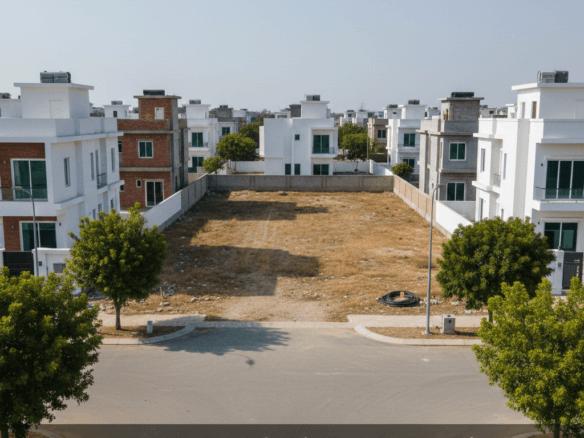
In several cases, discounted inventory exists because certain categories move more slowly — which is why evaluating cheap plots in DHA Karachi requires understanding liquidity, not just pricing.
Oversupply in Specific Plot Categories
Certain plot sizes sometimes face:
High resale inventory
Investor exit pressure
Limited end-user demand
For example, larger plots in certain phases may have fewer buyers compared to mid-sized plots.
When supply exceeds active demand, price movement slows.
Unrealistic Entry Price
Many investors overpay because:
They fear missing out
They trust optimistic projections
They ignore recent transaction trends
If entry price is too aggressive, future growth first compensates for overpayment — creating the illusion of stagnation.
Development vs Speculation Gap
In developing sectors, speculation often drives early price jumps.
But once:
Development pace slows
Possession timelines extend
Infrastructure visibility lags
Prices may remain flat until tangible progress appears.
Market Liquidity Differences Across Phases
Some DHA phases have:
High daily transaction activity
Active investor circulation
Others are more end-user dominant and slower moving.
Lower liquidity = slower visible price movement.
This is not weakness — it is structural behavior.
Economic & Policy Impact
Broader factors affecting DHA price movement include:
Interest rate environment
Tax policy changes
Political uncertainty
Currency stability
Even premium markets like DHA respond to macro signals.
Stagnation during uncertain periods is common and temporary.
Why Some Properties Move While Others Don’t
Within the same phase:
Two 500-yard plots can perform differently.
Performance depends on:
Street positioning
Access quality
Commercial proximity
Construction environment
Location micro-factors often decide appreciation speed.
The Difference Between Stagnation & Wrong Investment

 by
by 


Join The Discussion